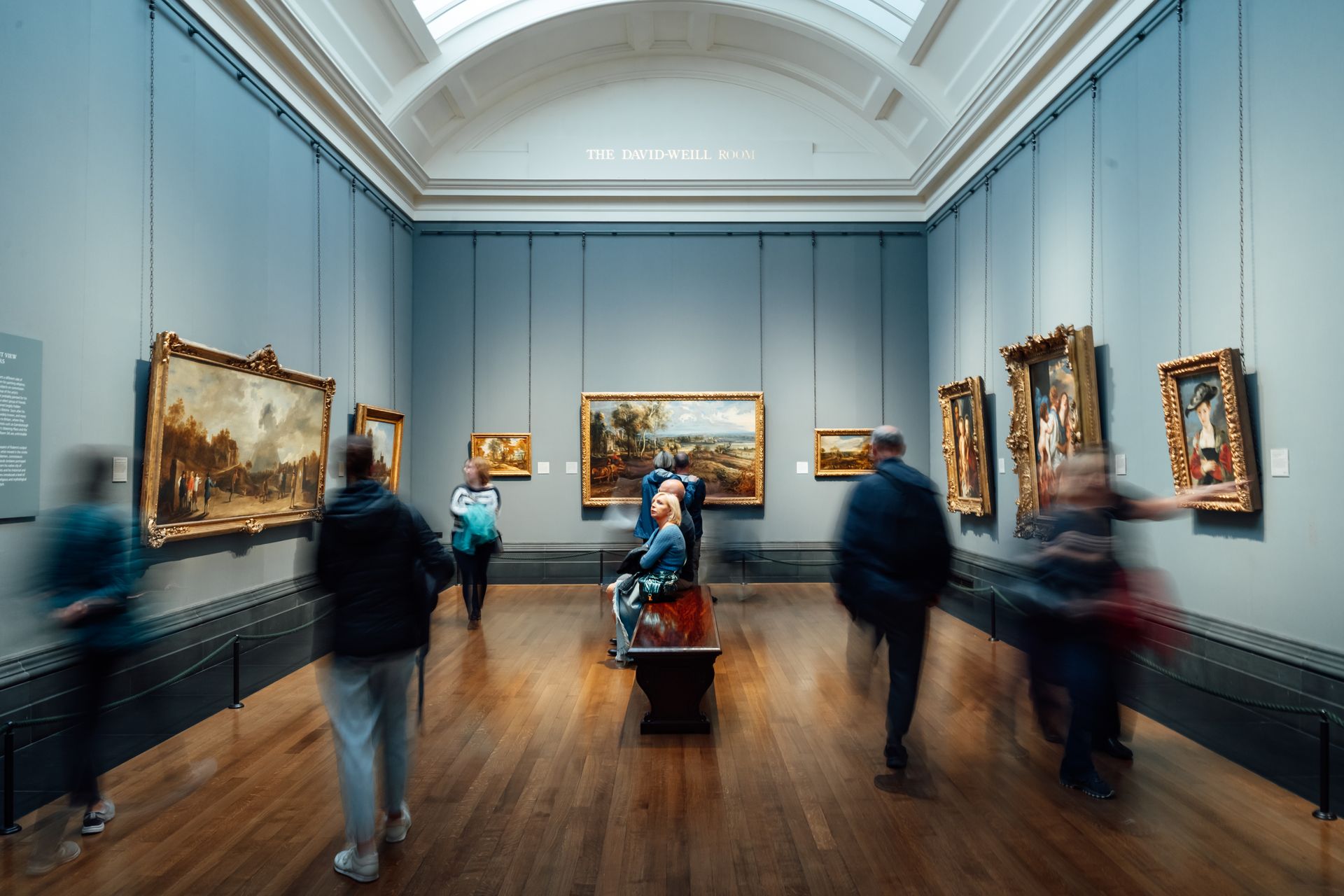
A family museum visit is social. Adults and children negotiate attention, pace, interests, care, movement, and meaning together. A successful family audio guide supports that relationship instead of placing every person in an isolated stream of narration.
The practical rule: design for shared looking, conversation, movement, and choice. Treat “families” as varied groups, give adults a useful role, and test the experience with real combinations of ages and needs.
1. Design for a social visit
Decide how the group will listen. One shared speaker can support conversation but may disturb others. Separate headphones can create immersion but fragment the group. Splitters, synchronized playback, short read-aloud prompts, and screen-based activities each create different dynamics.
Do not fill every transition with audio. Families need time to talk, move, negotiate, rest, and respond spontaneously.
2. Do not treat families as one audience
A toddler with a parent, siblings aged six and eleven, a teenager with grandparents, and a multilingual extended family are different visitor contexts. Research motivation, reading and listening confidence, adult expectations, time, language, disability, and familiarity with museums.
Avoid making the experience childish merely because children are present. Straightforward language, strong stories, visual evidence, humor, and meaningful questions can engage several generations.
3. Create shared attention
Direct the group toward something concrete: find a repaired edge, copy a pose, compare two faces, listen for a material sound, or choose which object tells the stronger story. The activity should return attention to the collection.
Use prompts that allow different observations instead of one hidden correct answer. “Which figure seems most powerful, and what makes you think that?” supports looking and discussion better than unrelated trivia.
4. Use questions, narrative, and play with purpose
Play can support exploration, experimentation, role-taking, imagination, and social interaction. Give it a clear interpretive relationship to the object or place. Points and badges may motivate some children, but external rewards can also shift attention from curiosity to task completion.
- Ask questions adults and children can answer together.
- Use choice, prediction, sound, movement, and making.
- Give feedback that adds meaning rather than only “correct” or “wrong.”
- Avoid tasks that require cultural knowledge the guide has not provided.
5. Control length, route, and cognitive load
Use a short essential route with optional stops. Alternate modes and emotional energy. Show how long an activity and route may take, and make it easy to stop without the experience feeling failed.
Each audio segment should complete one job. If a child has to hold several unfamiliar names and dates in memory before the point becomes clear, simplify the structure rather than merely speaking faster.
6. Give adults a useful role
Adults often mediate the museum themselves. Give them concise context, ways to extend a question, reassurance that there is no single required route, and support for children of different ages. Do not make the adult choose between learning personally and facilitating the child.
7. Design for access and recovery
Support transcripts, clear controls, adjustable audio, captions where video appears, readable text, sensory information, route choices, seating, and alternatives to actions requiring sight, hearing, speech, fine movement, or a personal device.
Explain how to rejoin after skipping, losing the route, or changing plans. Family visits are interruption-rich by nature.
8. Test with families
Observe the group, not only the interface. Who controls the device? Who looks at the object? Who becomes excluded? Does the prompt create conversation or conflict? When does the family move on? Interview adults and children separately and together where appropriate.
9. Where GuideSofia fits
GuideSofia can adapt routes, themes, depth, pace, and format to the group while preserving approved institutional content. The native app supports continuity across a destination; web access provides an immediate option for spontaneous visits.
10. Family-guide checklist
- The intended group dynamic is explicit.
- Children of different ages are not treated as one audience.
- Activities direct attention back to heritage.
- Adults receive value and facilitation support.
- Listening alternates with movement and conversation.
- The route is short, optional, and easy to leave or rejoin.
- Access needs and device alternatives are included.
- Real family groups participate in iterative testing.
Frequently asked questions
Should children have a separate museum audio guide?
Sometimes, but separation is not automatically better. Many family visits benefit from prompts and stories designed for shared adult-child attention and conversation, with optional age-appropriate depth.
How long should a children’s audio-guide stop be?
Use the shortest duration that completes the activity or interpretive purpose. Alternate listening with looking, movement, conversation, and choice rather than filling the visit with continuous narration.
Do quizzes make a family guide engaging?
Only when they support observation, conversation, or interpretation. Trivia that can be answered without looking at the object may add interaction without strengthening the museum encounter.
How should family guides be tested?
Observe real family groups with different ages, relationships, languages, confidence, and access needs. Test whether the experience supports the group rather than only whether a child can operate the interface.